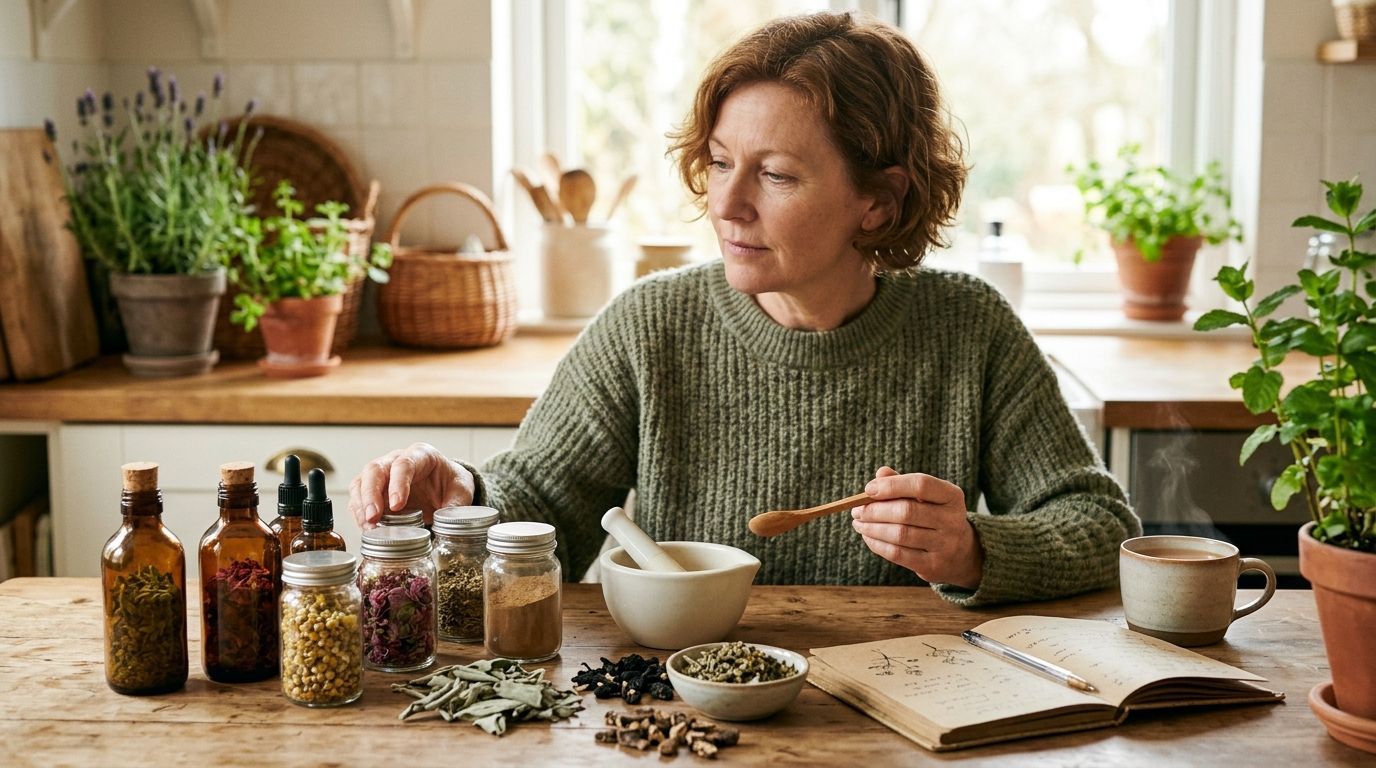
Perimenopause hits differently for every woman, and the herbal aisle can feel like guesswork. Here's the direct comparison: which herbal ingredients have real research behind them, what dose actually matches the studies, and which symptom each one is built to address.
- Ashwagandha (KSM-66), studied at 300-600 mg/day, is the best overall pick for stress and sleep support in 2026.
- Black cohosh, typically dosed at 40 mg of standardized extract, is the strongest herbal option for hot flashes and night sweats.
- Chasteberry (Vitex agnus-castus) at 20-40 mg targets mood swings and cycle irregularity, not hot flashes.
- No herbal supplement replaces medical care for perimenopause symptoms; match the ingredient to your specific symptom, not the marketing.
Why this matters
Estrogen and progesterone don't decline in a straight line during perimenopause — they swing, and that's what drives hot flashes, disrupted sleep, mood shifts, and irregular cycles. A lot of women want to try something before reaching for hormone therapy, and that's where herbal supplements come in.
The problem is that "herbal" doesn't mean interchangeable. Ashwagandha and black cohosh work through completely different mechanisms and target different symptoms. The Midlife List treats commission the same way regardless of which ingredient ranks first — it never determines inclusion or order, and that's the honest difference between this guide and a lot of the roundups you'll find in 2026.
What makes the best herbal supplement for perimenopause symptoms
- Standardized extract with a verifiable percentage — not just "black cohosh root powder" with no standardization listed
- A dose that matches the clinical research, not a fraction of it buried in a proprietary blend
- Third-party testing (USP, NSF, or ConsumerLab verification) on the label or company site
- Single-ingredient transparency — you can see exactly what you're taking and at what amount
- A match to your primary symptom — hot flashes, sleep, mood, and libido call for different herbs
- Documented interactions and cautions, especially for women on hormone therapy, blood thinners, or with a history of hormone-sensitive conditions
Herbal supplements for perimenopause at a glance
| Herbal ingredient | Best for | Standout feature | Key limitation |
|---|---|---|---|
| Ashwagandha (KSM-66) | Stress and sleep | Root-extract form studied at 300-600 mg | Not built for hot flashes specifically |
| Black cohosh | Hot flashes and night sweats | Most-studied herbal option for vasomotor symptoms | Not recommended with liver conditions |
| Chasteberry (Vitex) | Mood swings and cycle irregularity | Acts on the pituitary-ovarian axis | Can interact with hormonal birth control |
| Red clover / soy isoflavones | Bone and cardiovascular support | Phytoestrogen content mirrors dietary isoflavones | Avoid with estrogen-sensitive cancer history |
| Maca root | Low libido and energy dips | Non-hormonal mechanism, food-derived | Evidence is smaller and mixed |
| Valerian root | Occasional sleeplessness | Fast-acting for sleep onset | Daytime grogginess in some users |
| Evening primrose oil | Breast tenderness and skin dryness | High GLA (gamma-linolenic acid) content | Weakest evidence base of the group |
For the fuller category breakdown, The Midlife List's 7 best perimenopause supplements guide covers blended formulas alongside these single-ingredient options.
1. Ashwagandha (KSM-66): best herbal supplement for stress and sleep support
Ashwagandha is an adaptogenic root traditionally used to help the body manage stress, and KSM-66 is the specific standardized extract most often used in clinical research. Studies commonly test doses between 300 mg and 600 mg per day, taken with food.
Ashwagandha pros:
- Widely studied for cortisol and stress response support
- May traditionally help with sleep onset when taken in the evening
- Available in capsule, powder, and gummy formats
- Generally well tolerated at studied doses
Ashwagandha cons:
- Not studied specifically for hot flashes or night sweats
- Sedating for some users during the day
- Should be avoided or discussed with a doctor if you have thyroid medication or autoimmune conditions
Best for: women whose main perimenopause complaint is stress, racing thoughts at bedtime, or general overwhelm.
Verdict: Buy. This is the one we point women to first when sleep and stress are the loudest symptoms, and it's the best overall pick on this list for 2026.
2. Black Cohosh: best herbal supplement for hot flashes and night sweats
Black cohosh is a North American plant root that's the most-studied herbal option specifically for vasomotor symptoms — hot flashes and night sweats. Standardized extracts are commonly dosed around 40 mg per day.
Black cohosh pros:
- The strongest herbal evidence base for hot flash frequency and intensity
- Doesn't appear to act like estrogen in breast tissue, based on available research
- Widely available as a standalone standardized extract
Black cohosh cons:
- Rare reports of liver-related side effects mean it's not recommended for women with liver disease
- Results vary — some women notice a meaningful difference, others don't
- Effects typically take 4-8 weeks to become noticeable
Best for: women whose primary complaint is hot flashes or waking up drenched at night.
For a deeper comparison of options aimed at this exact symptom, see The Midlife List's guide to supplements for hot flashes and night sweats.
Verdict: Buy. If hot flashes are your main issue, this outranks ashwagandha for your specific symptom in 2026.
3. Chasteberry (Vitex agnus-castus): best herbal supplement for mood swings and cycle irregularity
Chasteberry, also called Vitex, acts on the pituitary gland rather than directly on estrogen, and it's traditionally used to help with cycle-related mood changes and irregular periods. Standardized extracts are typically dosed at 20-40 mg per day.
Chasteberry pros:
- Long history of use for PMS-type mood symptoms that often intensify in perimenopause
- May help support more regular cycle timing
- Non-hormonal mechanism of action
Chasteberry cons:
- Can interact with hormonal birth control and hormone therapy
- Not indicated for hot flashes
- Should be avoided during pregnancy
Best for: women dealing with irritability, PMS-like mood swings, or cycles that have become erratic rather than absent.
Verdict: Buy if mood and cycle irregularity are your top complaints; Skip if hot flashes are your main concern — it's not built for that.
4. Red Clover / Soy Isoflavones: best herbal supplement for bone and cardiovascular support during the transition
Red clover and soy both contain isoflavones, plant compounds that weakly mimic estrogen. Studied doses generally range from 40-80 mg of isoflavones per day.
Red clover / soy isoflavones pros:
- Isoflavone intake is associated with bone density and cardiovascular markers in observational research
- Food-based option for women who prefer dietary-style supplementation
- Widely available and inexpensive relative to other botanical extracts
Red clover / soy isoflavones cons:
- Should be avoided with a personal or family history of estrogen-sensitive cancers without medical clearance
- Evidence for hot flash relief specifically is mixed, weaker than black cohosh
- Effects on long-term bone health take months to assess, not weeks
Best for: women focused on longer-term bone and heart health alongside symptom management, not immediate hot flash relief.
Verdict: Hold — worth discussing with a doctor first given the estrogen-sensitivity caveat, especially if you have a family cancer history.
5. Maca Root: best herbal supplement for low libido and energy dips
Maca is a Peruvian root vegetable, not technically an herb but grouped here because it's sold and marketed alongside botanical menopause supplements. It doesn't act on hormones directly, which is part of its appeal. Studied doses run 1.5-3 grams per day.
Maca root pros:
- Non-hormonal mechanism makes it an option for women who want to avoid phytoestrogens entirely
- Some research points to support for libido and energy
- Food-derived, with a long history of dietary use
Maca root cons:
- Research base is smaller and less consistent than ashwagandha or black cohosh
- Not studied for hot flashes or sleep
- Gritty texture in raw powder form; capsules mask this better
Best for: women whose main frustration is low libido or flat energy rather than hot flashes or mood swings.
Verdict: Hold. Reasonable to try, but go in with realistic expectations given the thinner evidence base.
6. Valerian Root: best herbal supplement for occasional sleeplessness
Valerian is an herb traditionally used to help with occasional sleeplessness, distinct from ashwagandha's broader stress-support role. Common doses run 300-600 mg taken 30-60 minutes before bed.
Valerian root pros:
- Faster onset for sleep than adaptogens like ashwagandha
- Non-habit-forming at studied doses, unlike many sleep aids
- Often paired with chamomile or lemon balm in blended formulas
Valerian root cons:
- Can cause next-day grogginess in some users
- Strong odor and taste in raw extract form
- Not indicated for hot flashes, mood, or libido symptoms
Best for: women whose main perimenopause disruption is trouble falling asleep, separate from night sweats waking them up.
Verdict: Buy as a targeted sleep-onset tool; Skip if your sleep problem is actually night sweats — treat the hot flash first.
7. Evening Primrose Oil: best herbal supplement for breast tenderness and skin dryness
Evening primrose oil is pressed from the seeds of the evening primrose plant and is high in gamma-linolenic acid (GLA), an omega-6 fatty acid. Doses in studies range from 500 mg to 1,300 mg per day.
Evening primrose oil pros:
- May traditionally help with breast tenderness some women experience during hormonal fluctuation
- Some anecdotal support for skin dryness, a common perimenopause complaint
- Available in soft-gel capsules that are easy to add to a routine
Evening primrose oil cons:
- Weakest clinical evidence base of every item on this list
- Not shown to meaningfully reduce hot flashes in most trials
- Can interact with blood-thinning medication
Best for: women whose complaints are breast tenderness or skin dryness rather than hot flashes, mood, or sleep.
Verdict: Wait. Reasonable low-risk option, but don't expect it to move the needle on your bigger symptoms.
How we ranked these
Each ingredient was compared against the six criteria above: standardization, dose alignment with published research, third-party testing availability, label transparency, symptom specificity, and documented cautions. Ashwagandha and black cohosh ranked highest because they have the most consistent research and the clearest symptom match. Evening primrose oil ranked last because its evidence base is thinnest, not because of anything to do with affiliate commission — that never factors into order here.
See full 2026 menopause supplement picks
Compare complete ingredient lists and doses across top-rated formulas.
Which herbal supplement should you choose?
Start with the symptom that bothers you most, not the ingredient with the biggest marketing budget. Ashwagandha (KSM-66) is the best overall pick for 2026 if stress and sleep are your main complaints. If hot flashes and night sweats dominate, black cohosh has the stronger track record. If mood swings and cycle chaos are the issue, chasteberry fits better than either of those two.
For a broader look at how these herbal single ingredients stack up against blended and non-herbal options, The Midlife List's best menopause supplements guide walks through the full 2026 lineup side by side.
These statements have not been evaluated by the Food and Drug Administration. These products are not intended to diagnose, treat, cure, or prevent any disease. Talk to your doctor before starting any herbal supplement, especially if you take medication or have a hormone-sensitive condition. The Midlife List earns a commission on some links in this guide, but commission never determines inclusion or order.
FAQ
What is the best herbal supplement for perimenopause symptoms in 2026?
Ashwagandha (KSM-66) is the best overall herbal supplement for perimenopause stress and sleep support in 2026, while black cohosh is the stronger option specifically for hot flashes and night sweats.
Is black cohosh better than ashwagandha for perimenopause?
Black cohosh has stronger evidence for hot flashes and night sweats, while ashwagandha is better studied for stress and sleep. Match the herb to your primary symptom rather than picking one as universally better.
How long does it take for herbal supplements to work for perimenopause?
Black cohosh typically takes 4-8 weeks to show a noticeable effect on hot flashes. Ashwagandha's effects on stress and sleep can appear sooner, sometimes within 2-4 weeks at studied doses.
Can I take chasteberry and black cohosh together?
Some women combine chasteberry and black cohosh since they target different symptoms, but talk to a doctor first, especially if you're on hormonal birth control or hormone therapy.
Are herbal supplements safe with hormone replacement therapy?
Not automatically. Chasteberry and red clover isoflavones can interact with hormone therapy, so any herbal supplement should be reviewed with your doctor if you're on HRT.
What is the studied dose of ashwagandha for perimenopause stress?
Clinical research on ashwagandha, particularly the KSM-66 extract, commonly uses doses between 300 mg and 600 mg per day, taken with food.
Does evening primrose oil help with hot flashes?
Most trials on evening primrose oil don't show a meaningful reduction in hot flashes. It has more support for breast tenderness and skin dryness, which are separate perimenopause complaints.
Should I avoid soy isoflavones if I have a family history of breast cancer?
Talk to your doctor before taking red clover or soy isoflavones if you have a personal or family history of estrogen-sensitive cancer, since these compounds act like a weak form of estrogen in the body.
One last thing
The herb that gets the least attention on most 2026 roundups — valerian root — is also the one with the clearest, narrowest job: helping you fall asleep faster on nights when night sweats aren't the problem. If your sleep issue is really a hot flash issue, treating the hot flash with black cohosh will likely do more than stacking a sleep herb on top of it.
Keep exploring
One question leads to another.
Explore our answer library for practical guides and source links.
Browse the answer libraryThis is general educational information, not medical advice. Product details can change; review the current label and ask a qualified health professional about personal questions, medications, pregnancy, or health conditions.