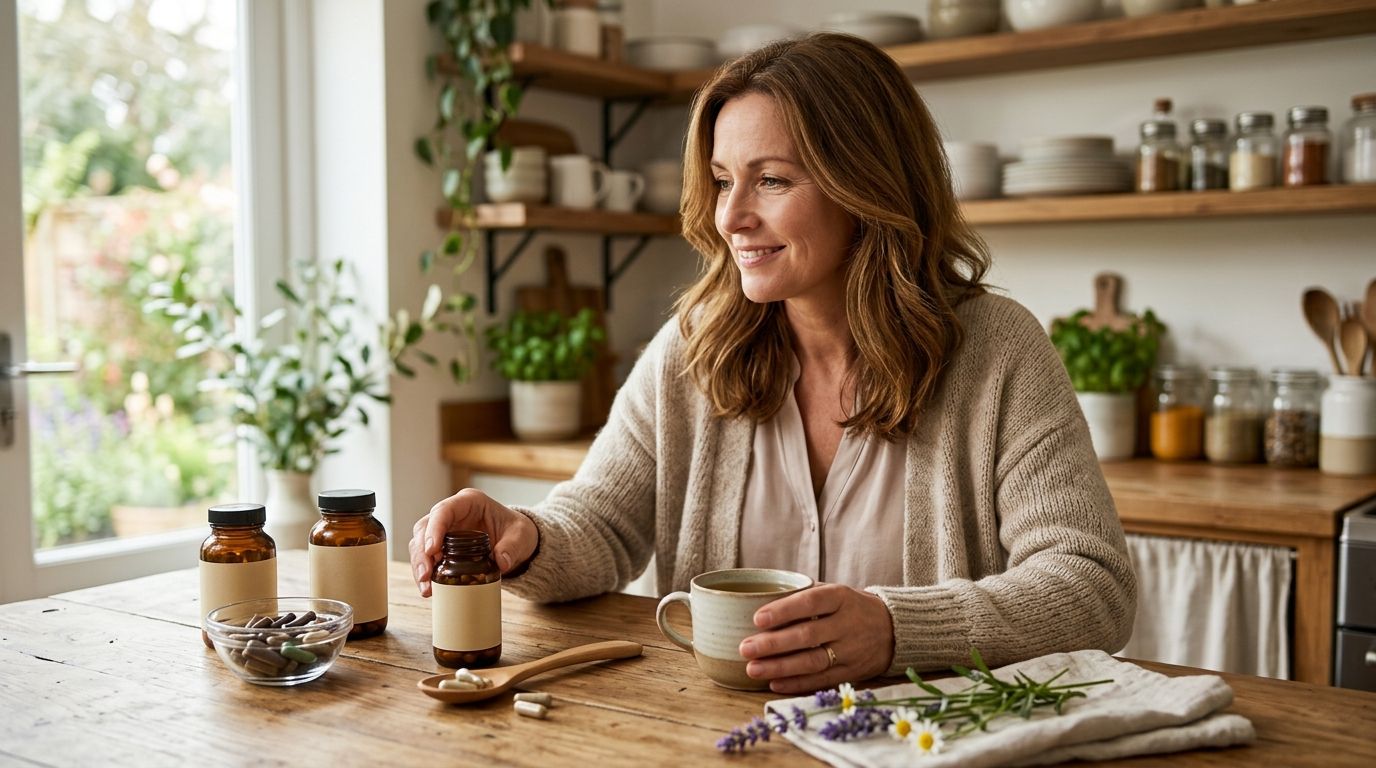
Perimenopause anxiety often shows up as a racing mind at 3 a.m., a short fuse by mid-afternoon, or a knot in your stomach that wasn't there five years ago — and the supplement aisle offers dozens of options that all claim to help. This guide ranks the mood-support ingredient categories worth trying first in 2026, based on studied dose ranges, label transparency, and how each one actually fits into a daily routine.
- Ashwagandha (KSM-66) is the best supplement for perimenopause anxiety for most women starting a routine in 2026.
- Magnesium glycinate helps most when anxiety shows up as poor sleep rather than daytime stress.
- L-theanine calms racing thoughts within about an hour but wears off quickly.
- Black cohosh blends target mood swings tied to hormone shifts, not general anxiety.
- Stack no more than two or three mood ingredients at once so you can track what's actually working.
Why this matters
Anxiety is one of the most commonly reported symptoms of perimenopause, alongside sleep disruption and mood swings tied to shifting estrogen and progesterone. This guide is part of The Midlife List's ongoing comparison of perimenopause and menopause supplements, and a broader roundup of perimenopause supplements covers how mood-focused ingredients fit alongside options for hot flashes, sleep, and energy.
Mood support supplements don't replace therapy, medication, or a conversation with a doctor — especially if anxiety is severe or you're already on an SSRI or benzodiazepine. What they can do is fill a gap: a lower-stakes, traditionally-used option for day-to-day edge that doesn't rise to a clinical diagnosis.
These statements have not been evaluated by the Food and Drug Administration. Mood support supplements are not intended to diagnose, treat, cure, or prevent anxiety or any other condition.
What makes the best mood support supplement for perimenopause anxiety
- Studied dose, not a fairy-dust amount. The label should list milligrams that match published research, not a proprietary blend that hides the number.
- A specific ingredient form. "Ashwagandha extract" is vague; "KSM-66" or "Sensoril" tells you which studied extract you're actually getting.
- Third-party testing. Look for NSF, USP, or Informed Choice marks — the FDA doesn't test supplements before they reach shelves.
- Cautious, non-medical label language. "May help support a calm mood" is honest; a claim to cure or treat anxiety is a red flag.
- Fits a routine you'll actually keep. A gummy you enjoy taking beats a capsule you skip.
- Clear interaction warnings. Especially for ashwagandha (thyroid conditions) and St. John's Wort (drug interactions).
Mood support supplements for perimenopause anxiety at a glance
| Ingredient category | Best for | Standout feature | Key limitation |
|---|---|---|---|
| Ashwagandha (KSM-66) | Daily stress support overall | Most-studied adaptogen for cortisol and mood | Not advised with some thyroid medications |
| Magnesium glycinate | Sleep-linked anxiety | High absorption, gentle on digestion | Slower-acting, not a same-night fix |
| L-theanine | Racing thoughts in the moment | Works within about an hour for many women | Effect is short-lived, not cumulative |
| B-complex vitamins | Budget-friendly baseline support | Covers multiple nutrient gaps at once | Mild mood support on its own |
| Black cohosh / blended formulas | Mood swings tied to hormone shifts | Pairs with other menopause-specific ingredients | Evidence on mood specifically is mixed |
1. Ashwagandha (KSM-66): best mood support supplement for daily stress in perimenopause
Ashwagandha is an adaptogen traditionally used to help the body manage stress, and KSM-66 is the specific root extract behind most of the clinical research on it. Studies commonly use doses around 600 mg per day, often split into two 300 mg doses. Goli Ashwa Gummies is one widely available option built on this extract, which matters if you know you won't stick with capsules.
Ashwagandha pros:
- Backed by more clinical research on stress and cortisol than most other botanicals on this list
- Available in gummy, capsule, and powder formats
- KSM-66 and Sensoril are both standardized extracts, so the milligram amount on the label is meaningful
Ashwagandha cons:
- Not recommended alongside certain thyroid medications without medical guidance
- Some women report vivid dreams or mild stomach upset when starting
- Effects build over weeks, not days
Best for: women whose anxiety feels like a constant background hum rather than sudden spikes.
Verdict: Buy — for most women starting a mood-support routine in 2026, this is the ingredient to try first. See the full ashwagandha gummies for menopause comparison for label-by-label detail.
2. Magnesium glycinate: best for anxiety that shows up as poor sleep
Magnesium glycinate pairs magnesium with glycine, an amino acid that's gentler on digestion than magnesium oxide or citrate. The NIH Office of Dietary Supplements lists the recommended daily amount for women over 30 at 320 mg, and many women in perimenopause run low due to diet and stress.
Magnesium glycinate pros:
- Well-absorbed and less likely to cause the loose-stool effect of cheaper magnesium forms
- Supports sleep quality, which indirectly eases next-day anxiety
- Widely available and easy to combine with other supplements
Magnesium glycinate cons:
- Doesn't address anxiety directly the way an adaptogen does
- Full effect on sleep and mood can take two to four weeks of consistent use
- Easy to accidentally double up if you're also taking a multivitamin with magnesium
Best for: women whose anxiety is worse after a bad night's sleep.
Verdict: Buy — pair it with ashwagandha rather than choosing one over the other.
3. L-theanine: best for racing thoughts in the moment
L-theanine is an amino acid found naturally in tea leaves. Research on relaxation and focus commonly uses a 200 mg dose, and many women notice a calming effect within 30 to 60 minutes without feeling drowsy.
L-theanine pros:
- Fast-acting compared to ashwagandha or magnesium
- Doesn't cause the sedation some calming supplements do
- Combines well with caffeine to blunt jitteriness
L-theanine cons:
- Effect wears off within a few hours, so it's not a foundation for all-day support
- Less research specific to perimenopause than ashwagandha
- Works better as an add-on than a standalone routine
Best for: the specific moment anxiety spikes — before a meeting, a hard conversation, or a flight.
Verdict: Hold — useful as a situational tool, not the core of a daily routine.
4. B-complex vitamins: best budget-friendly baseline support
B vitamins, especially B6 and B12, play a role in neurotransmitter production, and low levels have been linked to fatigue and low mood. A B-complex won't feel like a targeted anxiety supplement, but it covers a nutrient gap that can make everything else on this list work better.
B-complex pros:
- Generally inexpensive relative to targeted botanicals
- Supports energy and mood indirectly through nutrient sufficiency
- Low risk of interaction for most women
B-complex cons:
- Mild effect on mood specifically compared to ashwagandha or L-theanine
- Easy to over-supplement B6 if combined with a multivitamin
- Won't move the needle for anxiety alone if you're not actually deficient
Best for: women building a nutrient foundation before adding a targeted mood ingredient.
Verdict: Hold — a reasonable add-on, not a first choice for anxiety specifically.
5. Black cohosh and blended menopause formulas: best for mood swings tied to hormone shifts
Black cohosh is traditionally used to help with menopause-related symptoms, and studies on standardized extracts commonly use doses in the 20 to 40 mg range. Blended formulas pair it with ingredients like chasteberry or dong quai, aiming at hormone-driven mood swings rather than general stress.
Black cohosh pros:
- Targets hormone-linked mood swings specifically, not just generic stress
- Often bundled with hot flash support, addressing two symptoms at once
- Long history of traditional use for menopause symptoms
Black cohosh cons:
- Evidence on mood specifically is more mixed than the ashwagandha research
- Not recommended for women with liver conditions without medical guidance
- Blended formulas make it harder to know which ingredient is doing the work
Best for: women whose anxiety tracks closely with hot flashes or cycle changes rather than daily stress.
Verdict: Hold — worth trying if hormone-linked mood swings are the main complaint, otherwise start with ashwagandha.
How we ranked
Every ingredient category above is weighed against the same six criteria: studied dose match, ingredient form specificity, third-party testing availability, label language, routine fit, and interaction warnings. Ashwagandha ranks first because it has the deepest research base for stress and mood among botanicals commonly sold for perimenopause; the others earn their spot for a narrower use case rather than losing on quality.
Which mood support supplement should you choose in 2026?
If you want one supplement to start with in 2026, make it ashwagandha (KSM-66), taken consistently for at least four weeks before judging results. Add magnesium glycinate if sleep is the bigger issue, or keep L-theanine on hand for specific high-stress moments. Skip stacking more than two or three ingredients at once — it makes it harder to know what's actually working, and harder to catch a reaction if one shows up.
Compare full perimenopause supplement lineups
See label-by-label picks across ashwagandha, magnesium, and blended formulas.
FAQ
What's the best supplement for perimenopause anxiety?
Ashwagandha (KSM-66) taken at a studied dose around 600 mg per day is the best starting point for most women in 2026, based on the depth of research on stress and cortisol. Pair it with magnesium glycinate if poor sleep is part of the picture.
Is ashwagandha better than magnesium for perimenopause mood swings?
Ashwagandha has more research behind it for stress and mood specifically, while magnesium glycinate works better when anxiety is tied to sleep problems. Many women use both together rather than choosing one over the other.
How long does it take mood support supplements to work?
Ashwagandha and magnesium typically take two to four weeks of consistent use before effects are noticeable, while L-theanine can work within 30 to 60 minutes. Judge a routine over a full month, not a few days.
Can I take ashwagandha and magnesium glycinate together?
Yes, the two ingredients target different mechanisms and are commonly combined in perimenopause routines. Check with a doctor first if you take thyroid medication, since ashwagandha can interact with it.
Are mood support supplements safe with antidepressants or anti-anxiety medication?
Some ingredients, including St. John's Wort, interact with SSRIs and other prescription medications, so any mood supplement should be reviewed with a doctor first if you're on medication. Ashwagandha and magnesium have fewer known interactions but still warrant a conversation with a provider.
What ingredient should I avoid in a perimenopause anxiety supplement?
Watch for proprietary blends that hide the milligram amount of each ingredient, since there's no way to compare the dose to published research. Also flag any label claiming to cure or treat anxiety, which goes beyond what a supplement can legally claim.
Is L-theanine or ashwagandha better for racing thoughts at night?
L-theanine works faster, often calming racing thoughts within an hour, while ashwagandha builds a steadier baseline over weeks. Many women use L-theanine situationally and ashwagandha as the daily foundation.
One last thing
Most published ashwagandha studies run about eight weeks before measuring results — so judging it after a week of gummies undersells what the research actually shows. Give any mood support supplement a full month before deciding it isn't working.
Related guides
Keep exploring
One question leads to another.
Explore our answer library for practical guides and source links.
Browse the answer libraryThis is general educational information, not medical advice. Product details can change; review the current label and ask a qualified health professional about personal questions, medications, pregnancy, or health conditions.