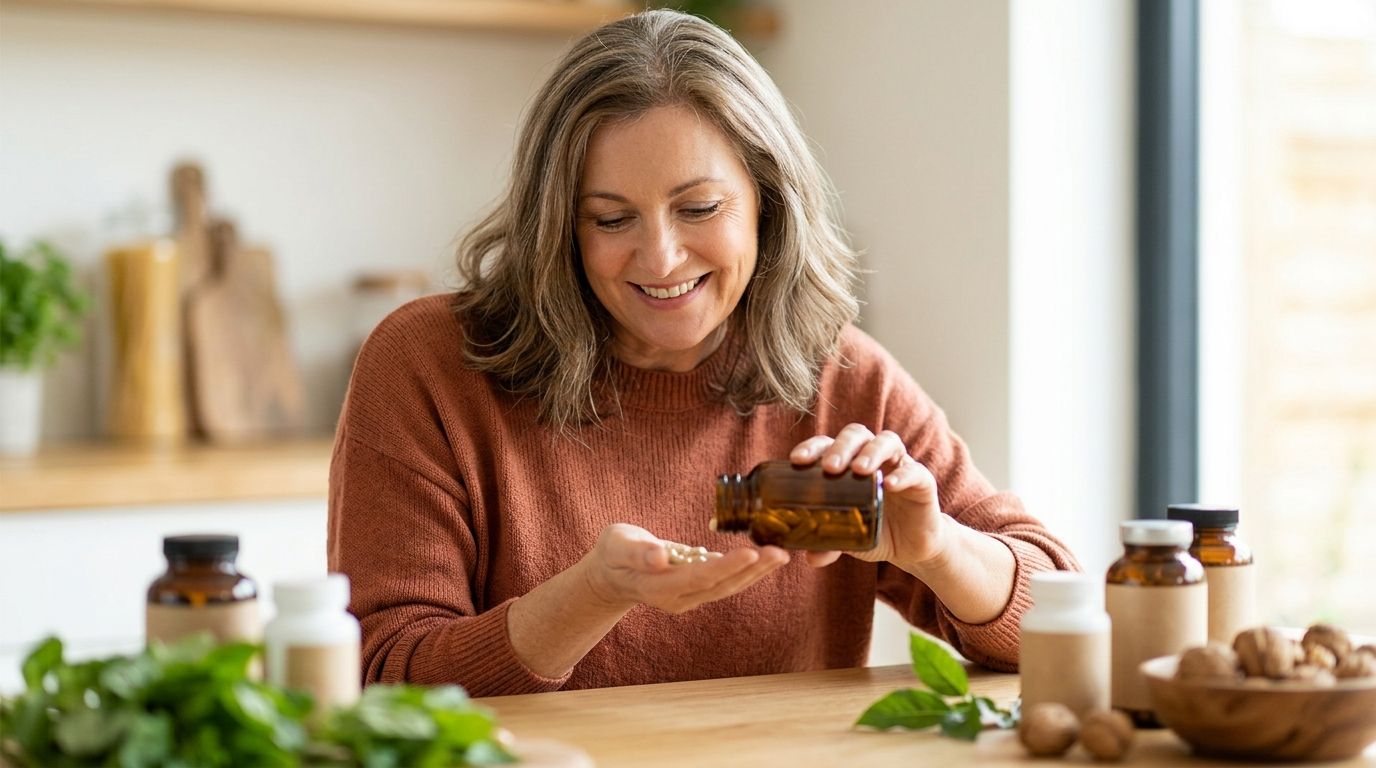
If your hair feels thinner at the part, sheds more in the shower, or just looks different than it did five years ago, hormone shifts in perimenopause and menopause are a common but under-discussed reason. The best supplements for menopause hair loss target a specific, testable cause — low ferritin, low vitamin D, chronic stress, or DHT sensitivity — instead of promising thicker hair from a jar.
- Iron repletion (after a confirmed low ferritin test) is the best supplement for menopause hair loss tied to heavy perimenopausal bleeding.
- Vitamin D3 and KSM-66 ashwagandha are the next-best options for deficiency- and stress-related shedding.
- Biotin is the most popular hair supplement but has the weakest evidence unless you're actually deficient, which is rare.
- Saw palmetto is worth trying for DHT-linked thinning but has thin research specifically on hair.
- Hair growth cycles run 3 to 4 months minimum, so no supplement shows results before then.
Why this matters
Hair thinning during perimenopause and menopause usually has more than one driver at once: falling estrogen, a slowing thyroid, iron loss from heavy periods, and cortisol from disrupted sleep all overlap. That's why a supplement chosen at random rarely works — it's treating a guess, not a cause.
The best menopause supplements in 2026 tend to be the ones that match a documented gap on a lab panel, not the ones with the biggest bottle. If night sweats and shedding are showing up together, it's also worth reading about supplements for hot flashes and night sweats, since poor sleep from hot flashes can itself drive stress-related shedding.
This guide is affiliate-supported — The Midlife List earns a commission on some links — but commission never determines what's included or how it's ranked. These statements have not been evaluated by the Food and Drug Administration. These products are not intended to diagnose, treat, cure, or prevent any disease, and none of them replace a conversation with your doctor about hair loss.
Best overall for confirmed deficiency: iron repletion. Best for stress-linked shedding: KSM-66 ashwagandha. Best budget baseline: biotin. Best for hormone-sensitive thinning: saw palmetto.
What makes the best supplement for menopause hair loss
- Targets a documented cause — low ferritin, low vitamin D, or a thyroid issue, not a guess
- Uses a studied dose, not a proprietary blend that hides the actual milligrams
- Discloses third-party testing (NSF, USP, or a certificate of analysis) on the label
- Sets a realistic timeline — hair grows in cycles, so 3 to 4 months is the minimum test window
- Doesn't crowd out medical care — a dermatologist visit or blood panel still matters
At a glance
| Option | Best for | Standout feature | Key limitation |
|---|---|---|---|
| Iron (ferritin-linked) | Confirmed low ferritin from heavy periods | Addresses a lab-documented deficiency directly | Requires a blood test; excess iron carries its own risk |
| Vitamin D3 | Widespread midlife deficiency | Inexpensive, well-studied for bone and immune health | Hair-specific evidence is indirect |
| Ashwagandha (KSM-66) | Stress-related shedding (telogen effluvium) | Clinical dosing at 300-600 mg is well established | Helps stress and sleep more directly than hair itself |
| Collagen peptides | Hair thickness alongside skin and nails | Studied doses of 2.5-10 g/day for skin elasticity | Less direct clinical evidence for scalp hair specifically |
| Biotin | A daily baseline multivitamin habit | Cheap, widely available, familiar ingredient | Weak evidence unless you're actually biotin-deficient |
| Saw palmetto | DHT-sensitive thinning at the crown | Traditionally used for hormone-linked hair concerns | Most research is on prostate health, not female hair loss |
1. Iron repletion: best for confirmed low ferritin
Heavy, irregular periods are common in perimenopause, and they can quietly drain iron stores years before menopause hits. When ferritin (stored iron) drops low, hair often sheds in a diffuse pattern rather than at one spot, and it's one of the more reversible causes on this list.
Iron pros:
- Addresses a documented, testable cause rather than a guess
- Effects on shedding are among the better-supported in the research
- The RDA for women 51 and older drops to 8 mg/day, so many women are already under-supplemented
Iron cons:
- Requires a blood test (ferritin, not just hemoglobin) before starting
- Iron overload is a real risk in women who aren't actually deficient
- Can cause constipation or stomach upset at higher doses
Best for: Women with heavy perimenopausal bleeding and a lab-confirmed low ferritin result.
Verdict: Buy — but only after a ferritin test confirms you need it.
2. Vitamin D3: best for widespread midlife deficiency
Low vitamin D is common in adults, and some research links deficiency to a hair-shedding pattern called telogen effluvium. It's not a hair-growth pill on its own, but it's one of the easiest deficiencies to correct.
Vitamin D3 pros:
- Inexpensive relative to most other options on this list
- Supports bone density, which matters more after menopause anyway
- Deficiency is easy to confirm with a simple 25-OH vitamin D blood test
Vitamin D3 cons:
- Evidence connecting it to hair regrowth specifically is indirect
- Fat-soluble, so very high doses over time need monitoring
- Won't do much if your levels are already normal
Best for: Anyone who hasn't had vitamin D levels checked in the last year.
Verdict: Buy — especially if a blood test shows you're low.
3. KSM-66 ashwagandha: best for stress-related shedding
Chronic stress and disrupted sleep can push hair follicles into a resting phase early, which shows up as shedding two to three months later. Ashwagandha, particularly the KSM-66 extract studied at 300-600 mg per day, has research behind it for lowering perceived stress and cortisol.
Women comparing formats often start with an ashwagandha gummy formulated for menopause since it's an easier daily habit to keep than a capsule regimen.
Ashwagandha pros:
- Well-studied dose range (300-600 mg) makes label-checking straightforward
- May help sleep and stress, which indirectly supports the hair growth cycle
- Available in gummy, capsule, and powder formats
Ashwagandha cons:
- Not a direct hair-growth ingredient — the connection is through stress reduction
- Interacts with thyroid medication and sedatives; check with a doctor first
- Gummy versions often carry a lower active dose per serving than capsules
Best for: Women whose shedding tracks closely with a stressful stretch or poor sleep.
Verdict: Try it — treat it as a stress and sleep tool that may help shedding as a side effect.
4. Collagen peptides: best for thickness alongside skin and nails
Collagen production naturally declines with age, and some women notice hair feeling thinner in diameter, not just fewer in number. Collagen peptides, typically dosed at 2.5-10 g per day, have more research behind skin elasticity than scalp hair specifically.
Collagen pros:
- Doubles as skin and nail support, which many women notice alongside hair changes
- Doses are well established from skin-elasticity research
- Generally well tolerated with few reported side effects
Collagen cons:
- Direct evidence for scalp hair density is thinner than for skin
- Often bovine or marine-sourced, which matters for anyone with dietary restrictions
- Daily powder or capsule routine adds another step to a supplement stack
Best for: Women noticing thinner-feeling strands alongside skin and nail changes.
Verdict: Try it if skin and nails are changing too — it's a lower-priority pick for hair alone.
5. Biotin: best for a low-cost daily baseline
Biotin (vitamin B7) is the most recognized hair-supplement ingredient on shelves, and it shows up in nearly every hair, skin, and nail blend. The catch: most published research on biotin and hair growth involves people who were actually biotin-deficient, which is uncommon in women eating a typical diet.
Biotin pros:
- Inexpensive and widely available in gummies, capsules, and multivitamins
- Very low risk of side effects at standard doses
- Easy starting point if you're not ready for lab testing
Biotin cons:
- Weak evidence for people who aren't deficient, and true deficiency is rare
- High-dose biotin can skew thyroid and other lab test results — tell your doctor before bloodwork
- Often the marketing headline on a label rather than the ingredient doing the work
Best for: Women who want a low-risk daily habit while investigating other causes.
Verdict: Consider it as a baseline, not the main plan.
6. Saw palmetto: best for DHT-sensitive thinning
Saw palmetto is traditionally used to help with hormone-related hair thinning, particularly patterns linked to DHT sensitivity at the crown or hairline. Standardized extracts are typically dosed around 320 mg per day, though most of the clinical research behind saw palmetto comes from prostate health studies rather than female pattern hair loss.
Saw palmetto pros:
- Traditionally used specifically for hormone-linked thinning patterns
- Standardized 320 mg extracts make dosing consistent across brands
- Plant-based and generally well tolerated
Saw palmetto cons:
- Direct research on female hair loss is thin compared to other uses
- Not a fit for shedding caused by stress or deficiency rather than DHT
- Can take several months before any change is noticeable, if it works at all
Best for: Women with a pattern of thinning specifically at the crown or part line.
Verdict: Wait and confirm the pattern with a dermatologist before committing to it long-term.
How we ranked these
Each option is ranked against the criteria above: whether it targets a documented cause, whether the dose matches published research, and whether the label is transparent about what's actually inside. Iron and vitamin D rank highest because low levels are common, testable, and directly tied to shedding in published research. Biotin ranks lower not because it's harmful, but because most women reaching for it aren't actually deficient.
Compare more menopause supplement picks
See how these options stack up against other 2026 picks for symptom relief.
Which one should you choose?
Start with a blood test, not a bottle: ferritin and vitamin D are the two most common, most fixable causes of menopause-era shedding, and both are cheap to check. If those come back normal and stress or poor sleep is the bigger issue in your life right now, KSM-66 ashwagandha at 300-600 mg is the more useful pick than another round of biotin gummies. Save saw palmetto for a pattern your dermatologist confirms is hormone-driven, and treat collagen and biotin as supporting players rather than the main plan.
FAQ
What is the best supplement for menopause hair loss?
There isn't one universal answer — iron repletion is the strongest option when a blood test confirms low ferritin, while KSM-66 ashwagandha (300-600 mg) is better matched to stress-related shedding. The right pick depends on the cause, not a single best-seller.
Does biotin actually help with menopause hair loss?
Biotin mainly helps when you're biotin-deficient, which is uncommon on a typical diet. It's low-risk as a daily baseline but isn't the strongest evidence-backed option on this list.
How long does it take for hair supplements to work?
Hair grows in cycles, so most changes take at least 3 to 4 months to show up, even when the supplement addresses the right cause. Judging results sooner than that isn't a fair test.
Should I get a blood test before trying hair supplements?
Yes — a ferritin and vitamin D panel identifies the two most common, fixable causes of menopause shedding before you spend money guessing. It also flags whether iron supplementation is safe for you.
Can stress really cause hair thinning during menopause?
Yes, chronic stress and poor sleep can push hair follicles into a resting phase, showing up as increased shedding weeks to months later. Ashwagandha's research is stronger for stress and sleep than for hair growth directly.
Is saw palmetto better than biotin for menopause hair thinning?
Saw palmetto is traditionally used for hormone-linked thinning at the crown, while biotin fills a general nutritional gap. Neither has strong direct evidence for female hair loss specifically, so the choice depends on the thinning pattern.
Can I take iron and vitamin D together for hair loss?
Many women take both, but iron should only be added after a ferritin test confirms deficiency, since excess iron carries its own health risk. Vitamin D is generally lower-risk to try after a simple deficiency check.
Do hair, skin, and nail gummies work for menopause thinning?
They can help if the ingredients (like collagen or biotin) match a real gap, but blended gummies often use lower doses than the standalone research versions. Check the label against the studied dose ranges before assuming it will work.
One last thing
The detail most women miss: hair you're shedding today was likely triggered by whatever happened 2-3 months ago — a stressful month, a rough sleep stretch, or a period that ran heavier than usual. That lag is why chasing the newest supplement rarely feels like it's working fast enough; the fix and the result are separated by an entire hair cycle, so patience matters as much as the ingredient list.
Related guides
Keep exploring
One question leads to another.
Explore our answer library for practical guides and source links.
Browse the answer libraryThis is general educational information, not medical advice. Product details can change; review the current label and ask a qualified health professional about personal questions, medications, pregnancy, or health conditions.