
Best overall for hot flashes and night sweats: black cohosh. Best for stress and cortisol support: ashwagandha (KSM-66). Best budget pick for sleep: magnesium glycinate. This guide ranks the six hormone balance supplement categories worth comparing for women over 40 in 2026, matched to the symptom you're actually trying to fix rather than one generic "best" pick.
- Black cohosh is the top pick among best hormone balance supplements for women over 40 dealing with hot flashes and night sweats.
- Ashwagandha (KSM-66) at roughly 600mg a day targets stress and cortisol, not vasomotor symptoms.
- Magnesium glycinate (200-400mg) is the most budget-friendly option for sleep and muscle tension.
- None of these six categories treat or cure a hormonal condition — they support symptoms alongside, not instead of, medical care.
Why this matters
"Hormone balance" gets used as a catch-all term, but the six supplement categories that actually show up in research target different things — a black cohosh extract and a magnesium glycinate capsule are not interchangeable. The menopause supplements guide on The Midlife List breaks down more categories than this page covers; here, the focus is narrower: which category fits which symptom in 2026.
The Midlife List earns commission on some links in this article, but commission never determines which category makes the list or where it ranks. Every pick below is judged on published dose ranges, label transparency, and how narrowly it targets one symptom instead of spreading thin across ten.
What makes the best hormone balance supplement for women over 40
- Ingredient form matches published research — KSM-66 ashwagandha or a standardized black cohosh extract, not a vague "ashwagandha root powder" with no extraction ratio
- Dose lands in the range studies actually tested, not a fraction of it buried in a proprietary blend
- Single clear symptom target instead of a 12-ingredient formula that dilutes every dose
- Label lists exact milligrams per ingredient rather than hiding behind "proprietary blend"
- Format you'll actually take daily — gummy, capsule, or powder, consistently
- Company discloses affiliate relationships and avoids diagnose/treat/cure language
These six categories cover six different jobs. No two compete for the same "best for" slot below — that's the point.
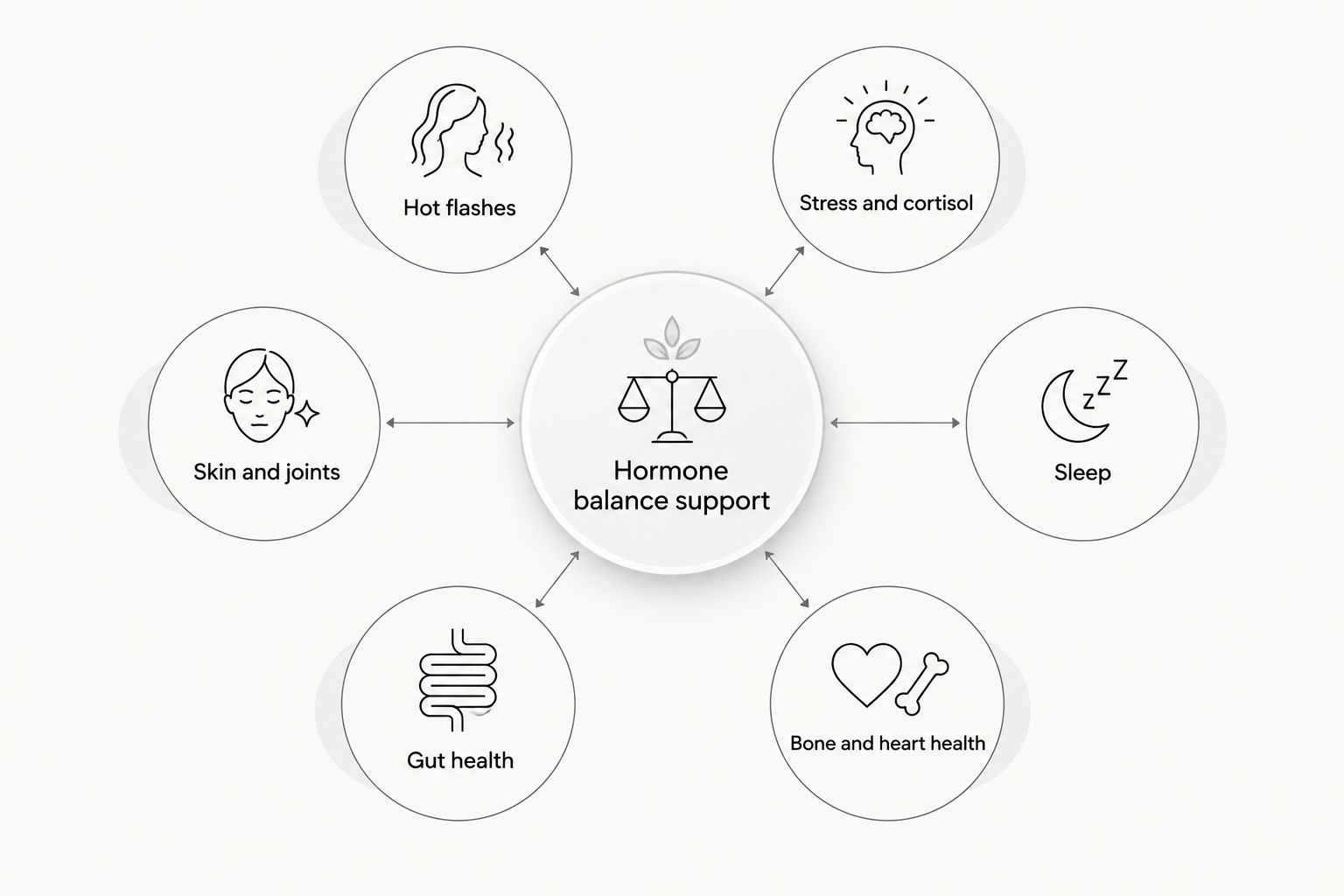
Hormone balance supplements at a glance
| Category | Best for | Standout feature | Key limitation |
|---|---|---|---|
| Black cohosh | Hot flashes and night sweats | Longest trial history among botanicals for vasomotor symptoms | Doesn't touch sleep, mood, or bone density |
| Ashwagandha (KSM-66) | Stress and cortisol | Studied at 600mg/day, split into two doses | Not shown to reduce hot flashes directly |
| Magnesium glycinate | Sleep and muscle tension | Gentler on digestion than magnesium oxide | Effect on hot flashes specifically is limited |
| Soy isoflavones | Bone and heart health, non-hormonal route | Plant-based estrogen-receptor activity | Interacts with hormone-sensitive conditions — check with a doctor |
| Probiotics | Gut health and bloating | Targets a symptom hormone shifts worsen indirectly | Not a hormone-balance ingredient on its own |
| Collagen peptides | Skin elasticity and joint comfort | Studied doses run 2.5-10g/day | No evidence for hot flashes, sleep, or mood |
1. Black cohosh: best for hot flashes and night sweats
Black cohosh is a botanical traditionally used to help with menopausal hot flashes and night sweats, and it has more clinical trial history behind it than most other single-ingredient options on this list. Standardized extracts in published research are commonly dosed around 40mg a day, split into two 20mg doses.
Black cohosh pros:
- Longest published trial history for vasomotor symptoms among single-ingredient botanicals
- Widely available as a standardized extract with a clear mg dose on the label
- Non-hormonal in the sense that it doesn't contain estrogen itself
Black cohosh cons:
- Doesn't address sleep, mood, or bone density
- Some formulas use unstandardized root powder, which won't match trial results
- Rare cases of liver concerns reported in case studies — check with a doctor if you have liver disease
Best for: women whose main complaint is hot flashes and night sweats, not the full symptom list.
Verdict: Buy — if vasomotor symptoms are your top complaint, black cohosh has more research behind it than most alternatives on this list.
2. Ashwagandha (KSM-66): best for stress and cortisol support
Ashwagandha is an adaptogen traditionally used to help the body manage stress, and KSM-66 is the specific root-extract form used in most of the published trials. A commonly studied dose is 600mg a day, split into two 300mg doses — a much higher amount than what shows up in many gummy formulas.
Ashwagandha pros:
- KSM-66 is the exact form used in the Chandrasekhar-style stress trials, so the dose on the label is checkable against research
- Gummy and capsule formats both exist, which helps with daily consistency
- May support sleep indirectly by lowering perceived stress
Ashwagandha cons:
- Not shown to reduce hot flashes or night sweats directly
- Many gummies dose well below the 600mg studied amount — check the label, not the marketing
- Can interact with thyroid medication; flag it to your prescriber
Best for: women whose main symptoms are irritability, racing thoughts, or stress-driven fatigue rather than hot flashes.
Verdict: Buy — for stress and cortisol specifically, ashwagandha (KSM-66) is the better first move than black cohosh.
3. Magnesium glycinate: best for sleep support
Magnesium glycinate is a mineral supplement in a form that's gentler on digestion than magnesium oxide or citrate, and it's a reasonable budget entry point since the RDA for women over 31 is 320mg a day from food and supplements combined. Many women fall short of that from diet alone once sleep and stress start compounding in their 40s.
Magnesium glycinate pros:
- Lower cost than most botanical extracts on this list
- Glycinate form causes less digestive upset than cheaper magnesium salts
- Supports muscle relaxation and may help with sleep onset
Magnesium glycinate cons:
- Doesn't address hot flashes, mood swings, or hormonal fluctuation directly
- Easy to overshoot the useful dose without checking total intake from food plus supplement
- Slower, subtler effect than a targeted botanical
Best for: women whose biggest complaint is restless or interrupted sleep, not vasomotor symptoms.
Verdict: Buy — as the budget option, magnesium glycinate covers sleep at a lower cost than the botanicals above it on this list.
4. Soy isoflavones: best non-hormonal option for bone and heart health
Soy isoflavones are plant compounds that act on estrogen receptors, studied in doses commonly ranging from 50 to 100mg a day. They're positioned differently from the botanicals above — the interest here is longer-term bone and cardiovascular support rather than immediate symptom relief.
Soy isoflavones pros:
- Doubles as a dietary pattern shift if you're already eating soy foods
- Studied for bone density and cardiovascular markers, not just hot flashes
- Available in capsule form with a clear isoflavone mg count
Soy isoflavones cons:
- Estrogen-receptor activity means it needs a conversation with your doctor if you have a hormone-sensitive condition or take tamoxifen
- Effect on hot flashes is more modest and inconsistent across trials than black cohosh
- Not a fast-acting option for acute symptoms
Best for: women prioritizing long-term bone and heart health over immediate symptom relief, and who've cleared it with a doctor.
Verdict: Hold — check with your doctor first if you're on hormone therapy or a hormone-sensitive medication before adding soy isoflavones.
5. Probiotics: best for gut health and bloating
Probiotics support gut bacteria balance, and gut symptoms — bloating, irregularity — often get worse during hormonal shifts even though probiotics aren't a hormone-balance ingredient in the direct sense. Commercial products vary widely in CFU count, so the label's strain names and count matter more than the marketing claims around them.
Probiotic pros:
- Addresses a real symptom (bloating, digestive discomfort) that spikes for many women in their 40s
- Doesn't carry the hormone-sensitivity caveats that soy isoflavones do
- Wide range of formats, including capsule and powder
Probiotic cons:
- Not a hormone-balance ingredient — it's addressing a downstream symptom, not the hormonal shift itself
- CFU counts and strains vary enormously between brands, making direct comparison hard
- Effects can take several weeks to notice, if noticeable at all
Best for: women whose main midlife complaint is digestive, not vasomotor or mood-related.
Verdict: Buy — for gut-specific complaints, but don't expect it to touch hot flashes or sleep.
6. Collagen peptides: best for skin and joint support
Hydrolyzed collagen peptides are studied for skin elasticity and joint comfort, with published trials commonly using daily doses between 2.5 and 10 grams. This category sits furthest from "hormone balance" in the direct sense — it's here because skin and joint changes are common midlife complaints that often get lumped in with hormonal symptoms.
Collagen pros:
- Studied dose ranges are well established for skin elasticity specifically
- Powder format mixes easily into a daily routine
- Addresses a visible, trackable change (skin, joint comfort) over weeks
Collagen cons:
- No evidence it affects hot flashes, sleep, or mood
- Results take weeks to months and are gradual, not dramatic
- Easy to overspend on a high dose when a moderate one is what's studied
Best for: women whose priority is skin elasticity or joint comfort, not core menopause symptoms.
Verdict: Skip — if hormonal symptoms are the priority, collagen isn't the category to start with; it's a secondary add rather than a first move.
How we ranked
Ranking here is based on published dose ranges from clinical research, whether the label discloses exact milligrams per ingredient, and how narrowly each category targets one symptom instead of spreading thin across many. A supplement that hits the studied dose for one clear symptom outranks a blend that touches ten symptoms at a fraction of each ingredient's effective amount.
“If a label doesn't list the milligrams per ingredient, you're guessing at whether you're anywhere near the dose the research actually used.”
Which hormone balance supplement should you choose?
If hot flashes and night sweats are the main complaint, start with black cohosh — it has the longest trial history among the six categories here. If stress, irritability, or racing thoughts are the bigger issue, ashwagandha (KSM-66) at the studied 600mg dose is the better first move. If sleep is the problem and budget matters, magnesium glycinate is the lower-cost entry point. Soy isoflavones and collagen are worth adding later, once the primary symptom is under control and you've checked isoflavones against any hormone-sensitive medication with your doctor.
These statements have not been evaluated by the Food and Drug Administration. These products are not intended to diagnose, treat, cure, or prevent any disease, and none of them replace hormone therapy or a conversation with your doctor about perimenopause or menopause symptoms.
Compare more menopause supplement categories
See how these six stack up against other options on The Midlife List.
FAQ
What is the best hormone balance supplement for women over 40 in 2026?
It depends on the symptom: black cohosh has the most trial history for hot flashes and night sweats, while ashwagandha (KSM-66) is better matched to stress and cortisol. There isn't one single best option across every symptom.
Is ashwagandha or black cohosh better for menopause symptoms?
Black cohosh targets vasomotor symptoms like hot flashes; ashwagandha targets stress and cortisol. They address different symptoms, so many women use them for different reasons rather than choosing one over the other.
How much KSM-66 ashwagandha should I take daily?
Published trials commonly used 600mg a day, split into two 300mg doses. Check the label against that figure, since many gummy formats dose well below it.
Can magnesium help with menopause sleep problems?
Magnesium glycinate, taken within the 320mg RDA for women over 31, may support muscle relaxation and sleep onset. It's not a fix for hot flashes or mood symptoms specifically.
Do hormone balance supplements actually work?
Some categories, like black cohosh for hot flashes, have more trial support than others. Results vary by person, and none of these supplements are a substitute for medical treatment of hormonal symptoms.
Are hormone balance supplements safe with hormone therapy or medications?
Soy isoflavones and black cohosh act on estrogen pathways and need a conversation with your doctor if you're on hormone therapy or a hormone-sensitive medication like tamoxifen. Ashwagandha can also interact with thyroid medication.
How long before hormone balance supplements start working?
Most labels and studies suggest giving an herbal or mineral supplement several weeks to a couple of months before judging results. Skin and joint changes from collagen tend to take even longer to notice.
Should I combine black cohosh, soy isoflavones, and ashwagandha?
You can combine categories that target different symptoms, but stacking multiple estrogen-receptor-active ingredients like black cohosh and soy isoflavones raises your cumulative exposure — flag any combination to your doctor first.
One last thing
The extraction and standardization on the label matters more than which plant is in the bottle. A black cohosh product labeled "root powder" with no extraction ratio is not the same thing the 2026 clinical trials tested — most of that research used a standardized extract, and a plain powder won't deliver the same measurable dose even at an identical weight on the label.
Related guides
Keep exploring
One question leads to another.
Explore our answer library for practical guides and source links.
Browse the answer libraryThis is general educational information, not medical advice. Product details can change; review the current label and ask a qualified health professional about personal questions, medications, pregnancy, or health conditions.